Good Riddance: Four Steps to a Clutter-free(ish) Home
Apologies for the month-long posting break. I had the best intentions about coming back from Christmas and immediately wrapping up the Catholic Home series. But first there was some reading I needed to do (for the new book on food and faith I’m writing). And then, this happened.
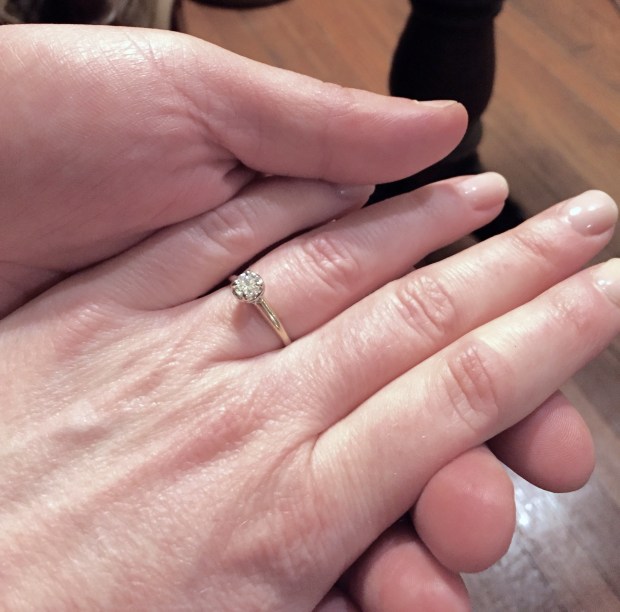
Needless to say, I’ve been a bit distracted.
We’ve set the date for July 1—this July 1—five months and four days from today. Not like I’m counting or anything.
This means in the next five months, I have a wedding to plan, a book to write, two ghosting projects to edit, and Guilder to frame for it. So, we’ll see how much blogging gets done. I’ll try, though. I’ll try.
In the meantime, I want to bring my most loved and most hated series of blogs to a quick end. Because I want to take more pictures of food.

Next week. For now...
As you'll recall, last time we talked about the importance of assessing why our houses get cluttered in the first place. That’s the really important post. If you can’t figure out why your house is packed to the rafters with clutter, all the organizing tips in the world aren’t going to help you. But, because I promised I would, I’ll share a few practical tips about how I combat the clutter in my own home. Take what works for you; adapt at will; ignore at leisure.
Everyone, of course, has a different idea of how much clutter is too much. One of my sisters and her husband, despite their three small children, live like Trappist monks. Leave so much as a hand on their kitchen countertop, and they just might remove it for you.
I’m not that crazy. I can deal with a pile of papers here or a stack of books there. Just not too many and not for too long. Overstuffed closets and tables covered in papers make me twitchy— partly because I have an easier time letting people into my house on a moment’s notice when it’s reasonably neat. But, more fundamentally, because I have a spiritual allergy to owning more things than I need or have room for. You can't take it with you and all that.
So, this is how I keep the twitching at bay.
Switch out my closets twice yearly.
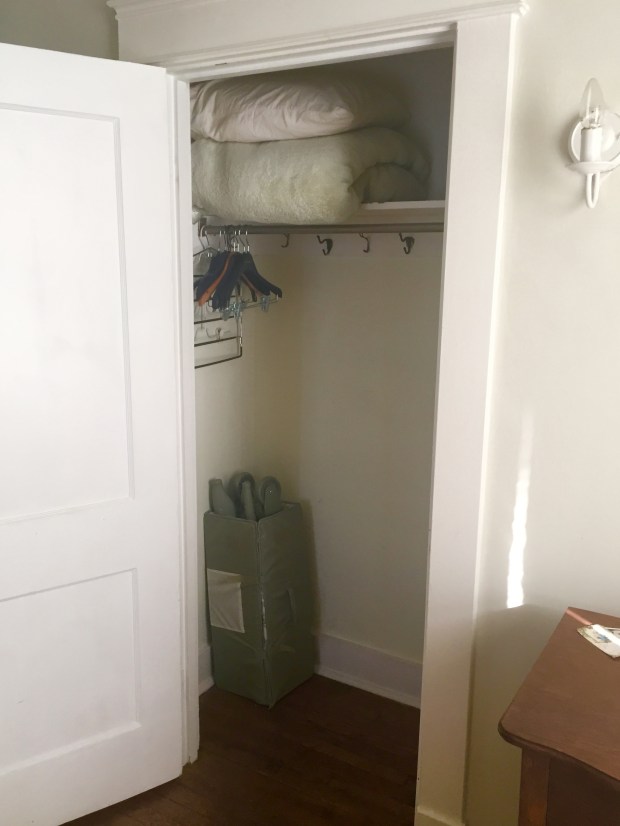
For nearly a century, married couples occupied the room that is now mine. And they managed just fine with one 2’x4’ closet.
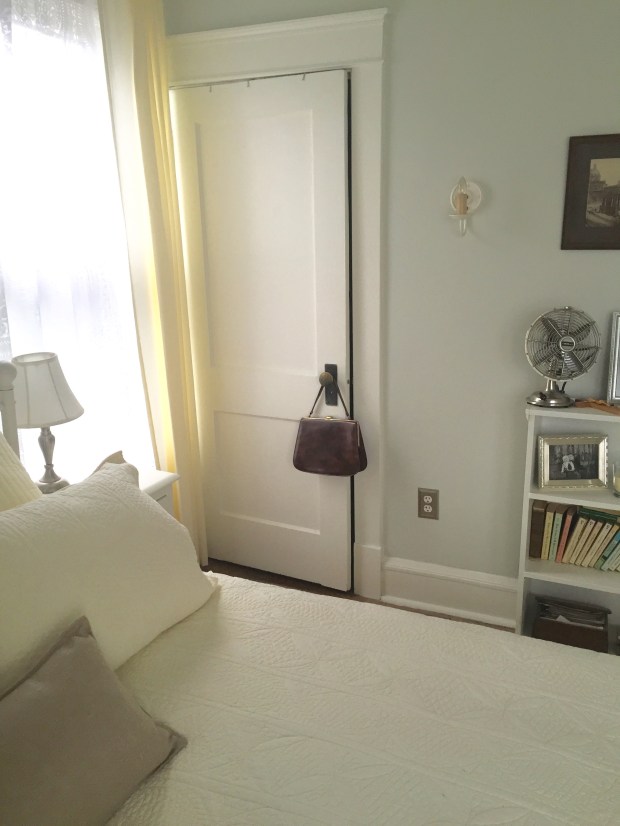
That’s right: 2’x4’. That’s tiny. Super-duper-crazy tiny by HGTV standards. But you know what? All those married couples still made it work. Somehow. So, I figure, there’s no reason I shouldn’t be able to do the same.
And yes, right now, it’s just me in my room. But in five months, there will be someone else sharing it with me. I want there to be room for his stuff. And there is. More than half the closet actually.
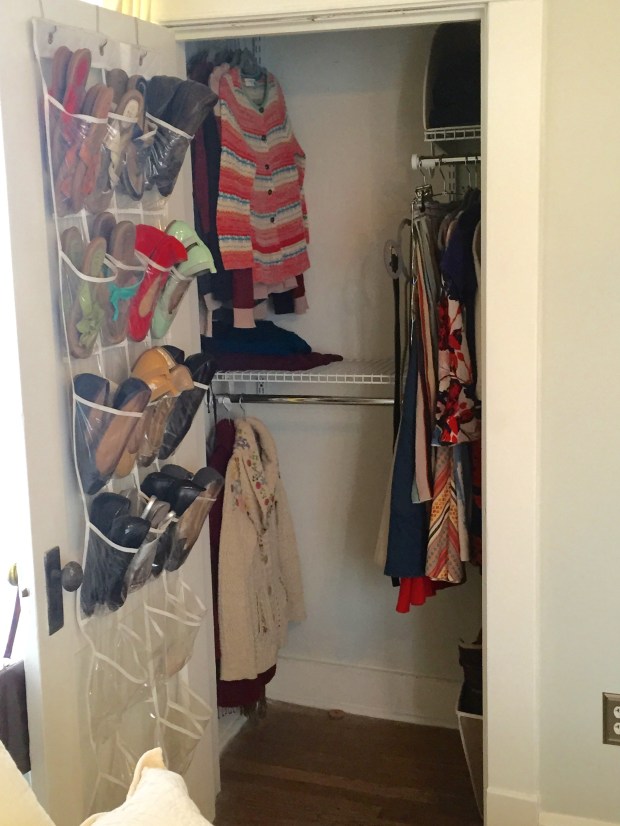
Sorry about the bad closet shots, but taking a decent picture of an unlit, 2'x4', 100-year-old closet on a cloudy winter's day with an iPhone is about what you'd expect it to be: impossible.
Regardless, here's the other third you can't see in the photo above, just so you know I'm not joshing you.
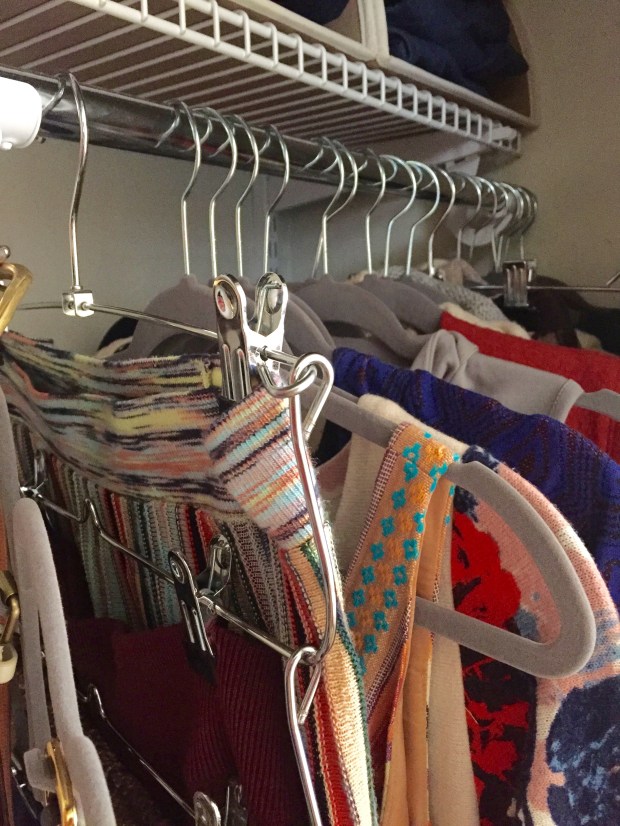
Just as a reminder, I do more than lay around the house in my yoga pants all day…although I do do a fair amount of that. When I’m not holed up, writing in leisure wear, my wardrobe has to get me through speaking gigs, tv appearances, date nights, formal events, meetings with clients, casual nights hosting at home, exercising, gardening, and lots of home repair projects. I also love beautiful clothes, fashion, and shopping. The women at Anthropologie know me by name.
But two seasons worth of my clothing can still fit into half of a four-foot closet (cleverly arranged) and one four-drawer dresser. Which is to say, if I can make it work, so can you.
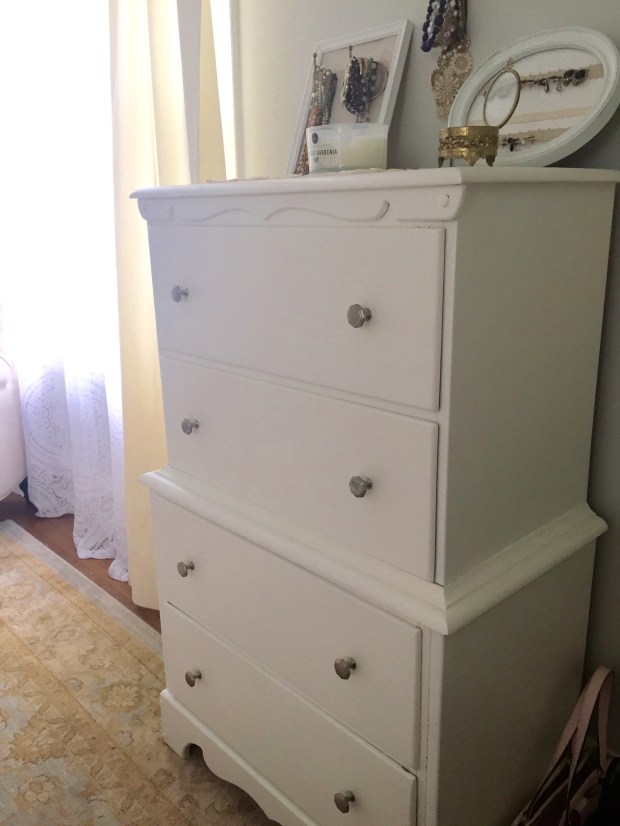
Switching out my closets (and a refusal to own more than I need) makes that possible because it forces me to repeatedly reevaluate everything I own and wear.
If, during that evaluation, I discover that something is in poor condition and beyond repair, it gets trashed.
If something is too big or too small (and there’s no reasonable chance I will wear it again before it goes out of fashion), it goes to the local mission. If there’s a chance I might wear it soon because I’m gaining or losing weight, it goes under the bed in a storage container—accessible, but out of the way (which is where maternity and transitional clothes will go if I get pregnant).
If I haven’t worn something the entire season (special occasion clothing excluded), it either goes to the mission, or into a “maybe box." If I haven’t broken into the "maybe box" by the end of the next year? You guessed it: to the mission.
In addition to the switching out of the closets, I also have a one in, one out policy: if I buy something new to wear (which is not replacing something old), then I have to give something away. This prevents me from buying too much or buying what I don’t need because it makes buying a high cost proposition: I’m not going to buy out of boredom or settle, if it’s going to cost me something I really like. It also keeps the overall quality of what I own fairly high. People end up thinking I have more clothes than I do because what I do have is well made, well cared for, and well suited to me.
Control the paper flow.
I have a lot of papers. A lot. My home is my home and my office. Moreover, the work I do in my office is produce more papers—interview transcripts, article drafts, book manuscripts. There will always be more papers in my house than there should be. But I do what I can.
First, in my living room, right next to the entryway table, is a pretty little trash can. As soon as I bring in the mail, I glance through it, tossing every piece of junk mail into that pretty little trash can straightaway.
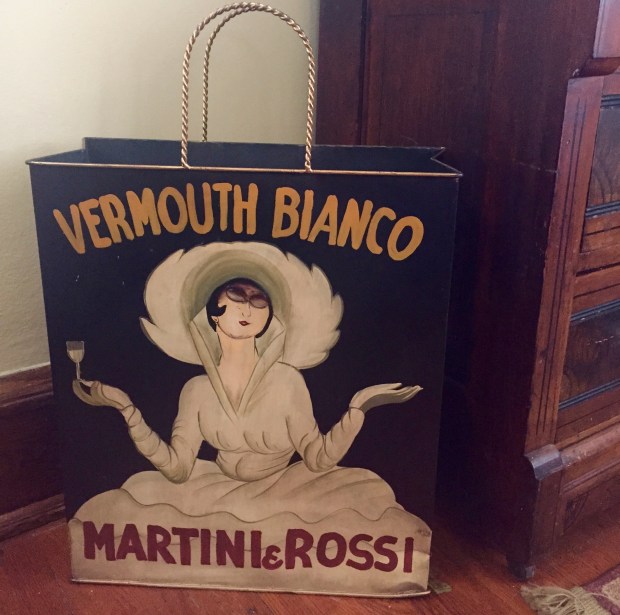
The mail I do need to deal with then goes to a bin in my office (admittedly, sometimes after a couple of days of sitting on the entry table). At the end of the week, I sort through the bin, writing checks, making calls, or filing papers as needs be.
I have other bins, both in my office and in my kitchen, to hold the papers pertaining to upcoming projects, receipts, recipes, and household bills. (They would work equally well for kids’ homework and permission slips if I had a family). My papers tend to get lost if I put them in stacks, so keeping them vertical and separated works better for me.
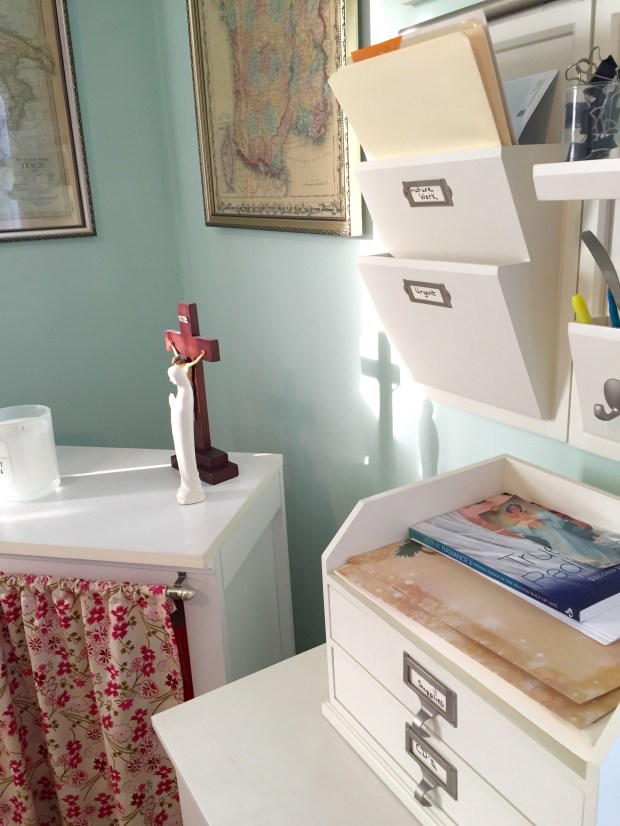
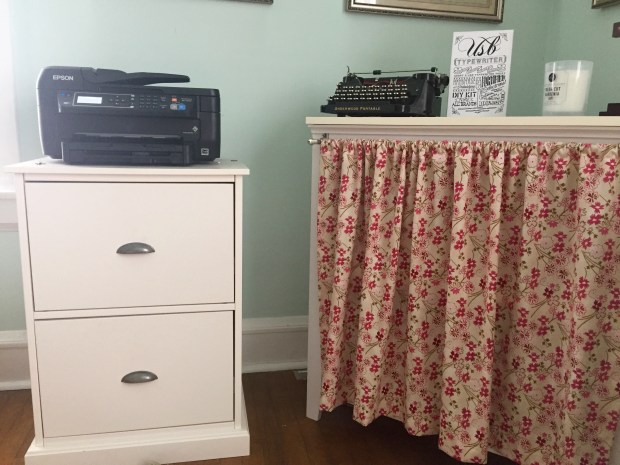
I also spent about $100 each on two filing cabinets from Target. Marie Kondo may advise against holding on to credit statements and utility bills, but the excuse, “Marie Kondo said I don’t need this” won’t fly with the IRS if my freelancing self ever gets audited. Proper storage doesn’t have to be expensive. It just has to do the job right.
I organize in 15-20 minute increments.
Life is crazy these days. I don’t have children. But I also don’t have a spouse or roommate to help with the cleaning, the errands, the bills, the laundry, the cooking, and the yard work. Nor do I have a secretary or intern to help with appointments, post office runs, interviews, travel plans, book orders, and scheduling.
I’m a one woman show for now, working 10-12 hour days; driving 90 minutes (minimum), to Pittsburgh and back, multiple times a week to see my fiancée; and trying to keep my house and life in decent enough shape that I can, in good conscience, blog about those things. And now I’m planning a wedding on top of all that.
I am exhausted and overwhelmed. But, having too much crud in my house will only make me more overwhelmed. So, I organize when I can: cleaning out the utility drawer or the cabinet under the sink while water boils; sorting through old DVDs while watching a show; straightening out the bookshelves while I'm on the phone.
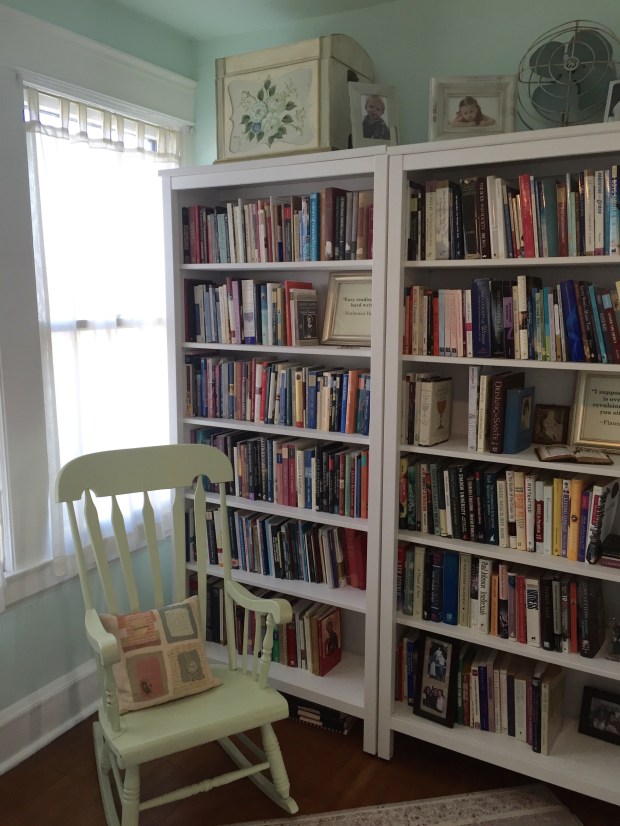
Basically, I just look for little moments where I can do little projects. It may not seem like much, but those little moments and little projects add up. Also, in the midst of the crazy, when so much is not getting done, it helps me feel like I've actually accomplished something.
Once a year, I pretend I’m moving.
It never ceases to amaze me how much stuff ends up in my basement utility room: random pieces of string, broken coffee mugs, old appliances, and lots of tiny “treasures” left by tiny guests. It’s just the detritus of life. Married or single, childless or fertile beyond your wildest hopes, crud will accumulate in your house as sure as the sun will rise, and if you don’t stay on top of it, it will take over.
That’s why, once a year, I play the “Let’s pretend I’m moving to a new house” game.
I know. Wild times over here. But it is kinda fun.
What I do is find a weekend where nothing is going on…block it out on the calendar…and go through every closet, cupboard, and corner of my house. As I do, I ask one question: Do I want to move this?
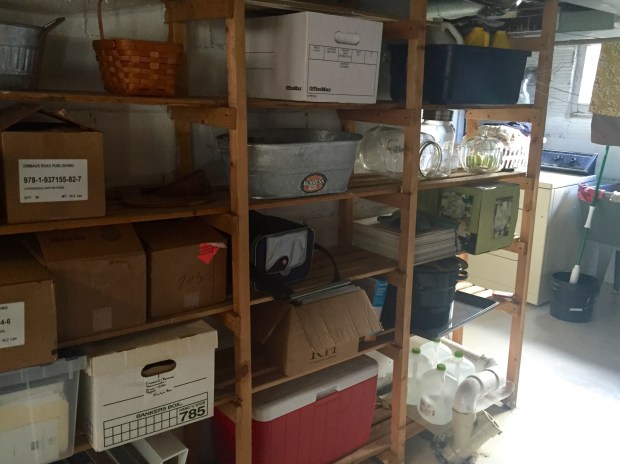
It’s shocking, given the annual nature of this event, how often the answer is “No.”
What I don’t want to “move” either goes to the trash, the alley (where the neighborhood scavengers quickly grab it), or the mission.
If you’ve never played this game before, it may take you more than a weekend. You might need to do a room a month instead. Also, if you have kids, you probably need to send them to Grandma’s for the day or hire a sitter or play "Frozen" on a loop . But once you start making a habit of it, the process goes much faster. And it really is fun. Promise.
***
So, that’s how I roll when it comes to clutter. I switch out my closets like clockwork. I control and organize the paper flow. I do one or two bite-sized organizational projects every week. And I do one great purge annually.
And the results?
I don’t need to use my attic to store anything (nada, zip, zilch). When we do eventually sell the house, that’s 900 plus square feet of space that I don’t need to worry about packing.
My cabinets and cupboards are all neatly arranged. There’s a space for everything and nothing falls out when I open a door.
The guest room closets and drawers are completely empty (save for extra blankets, pillows, and pack n'plays...because every single gal needs one...or two).
And the basement utility room shelves are neatly lined with the things I really do need to store: tools, off-season clothes, seasonal décor, the books I sell at conferences, athletic equipment, a FEW boxes of memorabilia, and occasionally used household items.
Yes, if I had more people living in the house, we would need to use more of the space. And yes, if I had little ones under foot, there would be more clutter to combat. And no, none of this makes me a holier woman closer to the unitive way. But it does make me happier and saner than I would otherwise be.
And frankly, at this point in my life, that's enough for me.
Addendum
When I first did the Catholic Home piece for OSV, I included a list of questions that can help with decluttering. They’re the questions I ask myself when organizing. Here they are again.
Questions to Ask When Cleaning Out the Closet
Does it fit?
Do I/my spouse/my child wear it?
Do I/my spouse/my child look good in it?
Is it modest?
Is it age-appropriate?
Is it in good condition?
Questions to Ask When De-Cluttering Bedrooms and Living Spaces
Is it beautiful?
Does it make me happy?
Is it necessary?
Does it reflect my personal tastes and interests?
Do I want to look at this every day?
Does it enhance the space or crowd it?
Questions to Ask When Organizing the Kitchen and Bathroom
Is this useful?
Does it work?
Do I use it often?
Do I have and need more than one of the same item?
Do I have space for it?
Does this belong in this room?
Questions to Ask When Organizing Storage Spaces
Do I still use this?
Is it in good condition?
If it’s broken or damaged, do have the time or money to fix it?
Do I need it?
Is it truly important to me, for sentimental reasons, to keep this?
If I had to move tomorrow, would I want to move this?
Previous Posts in The Catholic Home series:


Comments